
-
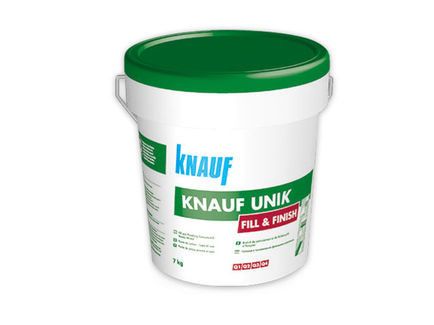
Unik Fill & Finish Knauf Slow Drying Joint and Finishing Paste
Vendor:KNAUFRegular price From 393,00 KčRegular priceUnit price per510,00 KčSale price From 393,00 KčSale -
Wood Wool Wood Chip Plate 60x60
Vendor:KNAUFRegular price 204,00 KčRegular priceUnit price per223,00 KčSale price 204,00 KčSale -
Box of 1000 Diamant XTN 3.9 mm screws from Knauf
Vendor:KNAUFRegular price From 470,00 KčRegular priceUnit price per516,00 KčSale price From 470,00 KčSale -
Knauf TN sheet metal screws
Vendor:KNAUFRegular price From 305,00 KčRegular priceUnit price per305,00 KčSale price From 305,00 Kč -
Reinforced corner guard tape with aluminum strips 30m Knauf
Vendor:KNAUFRegular price 497,00 KčRegular priceUnit price per547,00 KčSale price 497,00 KčSale -
Knauf 30m acoustic tape for plasterboard systems
Vendor:KNAUFRegular price From 267,00 KčRegular priceUnit price per293,00 KčSale price From 267,00 KčSale -
Knauf Renove 15kg gypsum-based renovation plaster cover for textured walls
Vendor:KNAUFRegular price 496,00 KčRegular priceUnit price per546,00 KčSale price 496,00 KčSale -
Knauf paper tape for joints 150m
Vendor:KNAUFRegular price 225,00 KčRegular priceUnit price per246,00 KčSale price 225,00 KčSale -
Knauf Aquapanel Grey Joint Mortar 20kg
Vendor:KNAUFRegular price 1.415,00 KčRegular priceUnit price per1.415,00 KčSale price 1.415,00 Kč -
Box of 1000 units self-tapping screws for fixing between metal LB 3.5mm Knauf
Vendor:KNAUFRegular price 303,00 KčRegular priceUnit price per334,00 KčSale price 303,00 KčSale -
Box of 1000 units TB 3.5mm screws for metal plate with drill point Knauf
Vendor:KNAUFRegular price From 499,00 KčRegular priceUnit price per559,00 KčSale price From 499,00 KčSale -
Box of 1000 units of fixing screws between plates PL-PL 5.5mm Knauf
Vendor:KNAUFRegular price 732,00 KčRegular priceUnit price per805,00 KčSale price 732,00 KčSale -
Box of 1000 units of Knauf XTN 3.9mm Anti-corrosion screws
Vendor:KNAUFRegular price From 610,00 KčRegular priceUnit price per671,00 KčSale price From 610,00 KčSale -
20kg bag of Knauf Unik 2h fast setting joint compound
Vendor:KNAUFRegular price 725,00 KčRegular priceUnit price per798,00 KčSale price 725,00 KčSale -
20kg bag of Knauf Unik Hydro 1h fast-setting, water-repellent joint compound
Vendor:KNAUFRegular price 809,00 KčRegular priceUnit price per890,00 KčSale price 809,00 KčSale -
Box of 100 units of splice for Knauf master profiles
Vendor:KNAUFRegular price 760,00 KčRegular priceUnit price per836,00 KčSale price 760,00 KčSale -
20kg bag of Knauf Unik Filler 1h fast setting joint compound
Vendor:KNAUFRegular price 743,00 KčRegular priceUnit price per817,00 KčSale price 743,00 KčSale -
20kg bag of Knauf Unik Filler 30min fast setting joint compound
Vendor:KNAUFRegular price 743,00 KčRegular priceUnit price per817,00 KčSale price 743,00 KčSale -
20kg bag of Knauf Unik 4h fast setting joint compound
Vendor:KNAUFRegular price 725,00 KčRegular priceUnit price per798,00 KčSale price 725,00 KčSale



Plasterboard plates
Why choose plasterboard panels for your projects?
At Brikum, we understand the importance of choosing quality and functional materials for your construction or remodeling projects. Plasterboard panels are an exceptional option for those seeking versatile, efficient, and durable wall and ceiling cladding solutions. These laminated gypsum boards stand out for their durability and adaptability, ideal for both domestic and commercial environments, providing a clean and professional finish.
Advantages of plasterboard panels
Plasterboard panels offer multiple benefits. Their lightness makes installation easier, saving time and reducing labor costs. They also boast excellent insulation, making them the perfect option for improving the thermal and acoustic comfort of any space. And if you're thinking about sustainability, plasterboard is a recyclable material, contributing to more environmentally responsible projects.
Versatile and practical applications
These panels are ideal for creating partition walls, false ceilings, and custom design solutions. Thanks to their adaptability, they can be used in all types of buildings, from residential to office or commercial spaces. Plasterboard panels also allow the addition of doors and windows without compromising stability, adding flexibility to your design ideas.
Find the ideal plasterboard panel at Brikum
At Brikum, we'll help you find the plasterboard that best suits your specific needs. We pride ourselves on offering high-quality products, backed by years of experience and a professional team that will guide you every step of the way. Our mission is to ensure you have the right materials to achieve the best results for your projects.
What is plasterboard partitioning?
Plasterboard partitioning is a construction technique that uses laminated gypsum board, also known as plasterboard, to create interior partitions without the need for brick or cement walls. This method is ideal for those seeking a quick, flexible, and aesthetically pleasing solution, allowing for efficient space design that adapts to different styles and needs.
At Brikum, we offer a wide variety of drywall panels so you can find the perfect option for your project. Our team of experts can advise you on the most suitable materials and the best installation methods to ensure high-quality finishes.
What is joint paste and what is it used for?
Joint compound is a fundamental material in drywall installation, especially for partition walls. The main function of joint compound is to cover and join the joints between drywall, creating a smooth, even finish that hides the joints and ensures the surface is ready for painting or decorating. Additionally, joint compound is used to fill screws and small imperfections, achieving a professional and long-lasting finish.
At Brikum, we offer different types of joint compound to suit every project, whether for quick finishes or high-strength finishes. Our team of specialists can help you find the ideal product for your needs and type of project.
Advantages of using joint paste in partition walls
1. Smooth and continuous finishes
Joint compound creates a smooth, blemish-free surface. This is essential for a clean, professional finish on plaster walls or ceilings. When used correctly, the gaps between plasterboards disappear, contributing to an aesthetically pleasing finish.
2. Strength and durability
This material not only improves the appearance of plaster walls, but also provides strength to the joints, ensuring they don't crack or deteriorate over time. Joint compound is especially useful in areas subject to temperature or humidity fluctuations, as it helps prevent cracks.
3. Easy application and quick drying
The joint compound is easy to apply with simple tools such as a spatula or trowel. Its quick drying speeds up installation work and allows for multiple coats to achieve the desired finish in less time.